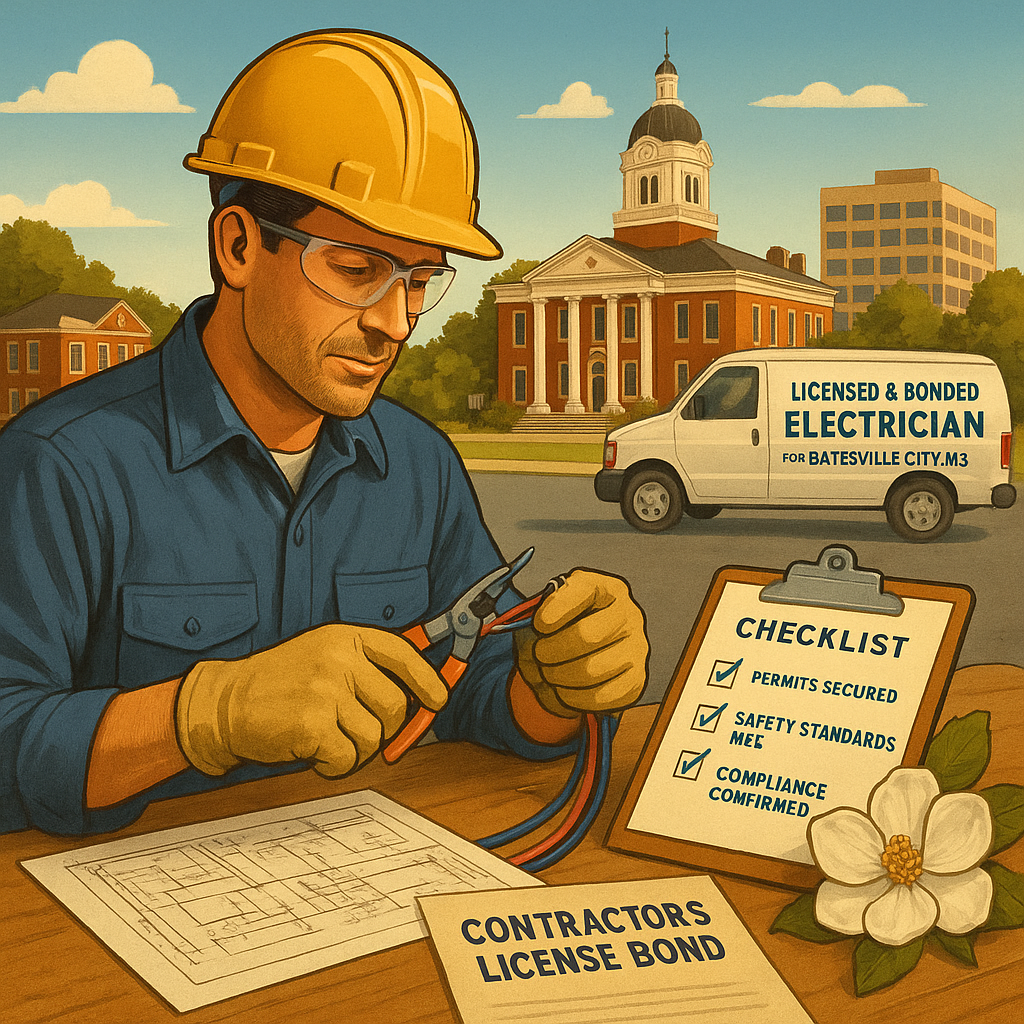
So, you’re an electrician in Batesville, Mississippi—or maybe you’re planning to become one. You’ve got the skills, the tools, and probably a truck full of wire and conduit, ready to take on any job that comes your way. But before you can pull a permit or start rewiring an old downtown building, the City of Batesville asks for something extra: a contractor’s license bond. If the phrase “electrician – compliance only” popped up during your research, and you’re scratching your head, don’t worry. You’re not alone. Let’s break this down step by step and make it crystal clear.
Assuming your bond cost is just a simple percentage
The most costly mistake is thinking your Oregon contractor license bond premium is a fixed rate like 1% or 2% of the bond amount. In practice, your final cost is determined by an underwriter reviewing your personal credit score, financial statements, and business history. Applicants with lower credit often pay 3-5% or more. What slows this down is not having your financials ready. The part most applicants underestimate is how much a strong credit profile can reduce your annual premium.
- Your personal credit score is the primary factor in your final rate.
- Have 2 years of business and personal financial statements prepared for review.
- A higher bond amount doesn't mean a proportionally higher cost; underwriting is key.
What Exactly Is a Contractor License Bond?
Think of a contractor license bond as a promise you make to the city and your customers. It’s not the same as insurance, and it’s not a rainy-day fund for your business. Instead, it works almost like a safety deposit. The bond says, “I agree to follow all the local rules, codes, and regulations that govern electrical work in Batesville. If I don’t, this money is available to make things right.”
To put it even more simply: imagine renting an apartment. The landlord asks for a security deposit. You follow the lease, leave the place in good shape, and you never hear about that deposit again. A license bond is similar—only the “lease” here is the city’s building codes and business laws. As long as you play by the rules, the bond just sits quietly in the background.
Why Does Batesville MS Require This Bond for Electricians?
Every city wants to protect its residents. Shoddy electrical work isn’t just an inconvenience; it’s a genuine safety risk. A loose connection or an improperly sized breaker can lead to fires, property damage, or worse. The bond is one of the tools Batesville uses to hold electricians accountable. It’s not about doubting your skills—it’s about having a clear, financial backup plan for the community.
When you obtain a City of Batesville MS Contractor’s License Bond, you’re sending a clear message: you stand behind your work and you respect the local standards. In return, the city grants you the permission to operate legally. No bond? No license.
The “Compliance Only” Distinction: What Does That Mean for You?
Here’s where things get interesting. You might have seen the term “compliance only” attached to electrician bonds in Batesville. Does that cover shoddy workmanship? Does it guarantee you’ll finish a job on time? Not exactly.
A compliance-only bond focuses exclusively on your adherence to city codes and ordinances. Let’s say you complete an electrical panel upgrade, but an inspector later finds that the work doesn’t meet the National Electrical Code as adopted by Batesville. A claim could be filed. However, if a customer is simply unhappy with the color of the outlet covers you installed, that’s not what this bond handles. It’s not a general liability policy, and it’s not a performance bond.
This narrow focus is actually good news for you. Because the bond’s scope is limited to regulatory compliance, surety companies see it as lower risk. That often translates to a more affordable premium compared to broader, more complex bonds.
Breaking Down the Bond: The Three Key Players
To really grasp how the bond operates, let’s introduce the three parties involved. Don’t worry, there’s no exam at the end.
- The Principal: That’s you, the electrician. You’re the one buying the bond and promising to do things by the book.
- The Obligee: This is the City of Batesville, requiring the bond. They’re the ones protected by it.
- The Surety: The company that issues the bond. They act as a financial backer, guaranteeing that you’ll keep your promises.
If you violate the city’s electrical codes and someone files a valid claim, the surety may pay out first. But here’s the kicker: unlike insurance, where the insurer takes the loss, the surety will come back to you, the electrician, for reimbursement. The bond is a form of credit, not a payout system for your mistakes.
How Much Does a Batesville Electrician Bond Cost, and How Do You Get One?
Now for the practical stuff. You won’t be paying the full bond amount out of pocket. Most electricians in Batesville need to post a bond with a specific coverage limit set by the city—often something like $5,000 or $10,000. But you only pay a small percentage of that as a premium.
What determines your price? The surety company looks mainly at your personal credit score and your business history. A strong credit profile may land you a premium as low as 1% to 3% of the total bond amount. That means a $10,000 bond could cost as little as $100 a year. Even with less-than-perfect credit, you can usually still get bonded, though the percentage might be a bit higher.
Getting the bond itself is actually one of the simpler parts of the licensing process. Here’s a typical path:
- Reach out to a surety bond agency that works with Mississippi contractors.
- Fill out a short application with basic personal and business details.
- Receive a quote, often within minutes or hours.
- Pay the premium and get your official bond form.
- File that bond with the City of Batesville as part of your license application.
That’s it. No long seminars, no confusion.
What Happens If You Work Without One?
It’s tempting to think, “It’s just a piece of paper. Who’s going to notice?” The truth is, the city notices. Working without the required contractor’s license bond can get you into serious trouble. We’re talking about fines, immediate suspension of your license, and a firm stop on any permits you try to pull. A homeowner could even use your lack of a bond as a reason to withhold payment or file a complaint.
Worse, if you do unpermitted work and something goes wrong, your business insurance might not cover the damages because you were operating illegally. That’s a financial pit that could swallow your entire enterprise. The bond isn’t a bureaucratic hassle—it’s a shield for both you and the people you serve.
The Hidden Benefits: More Than Just Red Tape
Once you have your Batesville MS Contractor’s License Bond in place, something shifts. New customers often ask, “Are you bonded and insured?” Being able to answer “yes” without hesitation builds instant trust. It tells a homeowner that you’re a legitimate professional, not someone who might vanish halfway through a kitchen remodel.
It also levels the playing field. The bond requirement filters out contractors who cut corners or undercut prices because they skip the licensing process entirely. When you’re bonded, you’re competing with other qualified electricians who take the same pride in doing things right.
Common Misunderstandings to Clear Up Right Now
Let’s tackle a few mix-ups we hear all the time. First, as I hinted earlier, a bond is not insurance. Your general liability policy steps in if you accidentally drill through a water pipe. The bond steps in if you knowingly or unknowingly break a local building code and the city gets involved. They serve different purposes, and one doesn’t replace the other.
Second, the bond doesn’t cover all possible disputes. If a customer simply decides they don’t like the final bill, the surety isn’t an arbitrator for contract disagreements. The claim has to tie back to a violation of municipal regulations.
Finally, the bond is not a one-time purchase you can forget about forever. Most bonds need to be renewed annually, often aligned with your license renewal. Keep the expiration date on your radar—a lapsed bond means a lapsed license.
Tips for a Smooth Bonding Experience
Want to keep that bond sitting quietly in a drawer rather than becoming a headline? Here are a few friendly suggestions.
- Know your codes cold. The City of Batesville adopts specific editions of the NEC. Stay current, because even a minor violation can trigger problems.
- Document your work. Photos before, during, and after, along with clear invoices, can be your best defense if someone questions your compliance.
- Communicate openly with inspectors. Most issues are caught and corrected before a claim is ever filed. A cooperative attitude goes a long way.
- Shop for your bond wisely. Not all agencies charge the same rate. Compare quotes, but also check reviews—you want a surety that handles claims fairly and quickly.
Pulling It All Together
Look, we get it. Navigating city regulations can feel like trying to untangle a knotted extension cord. But the contractor license bond requirement for electricians in Batesville, Mississippi, is really just a formal handshake between you and the community. You promise to uphold the safety standards that keep families safe, and the city gives you the green light to operate. The “compliance only” nature of the bond simplifies things: it’s laser-focused on codes, not on every possible customer complaint.
So, as you load up the van and head to your next job along Panola Avenue or the streets near downtown, you can do it with the confidence that comes from being fully licensed and properly bonded. It’s not a hurdle; it’s part of the foundation that makes your electrical business reliable, respected, and ready to grow.